Dhaka 3:24 am, Wednesday, 25 November 2026

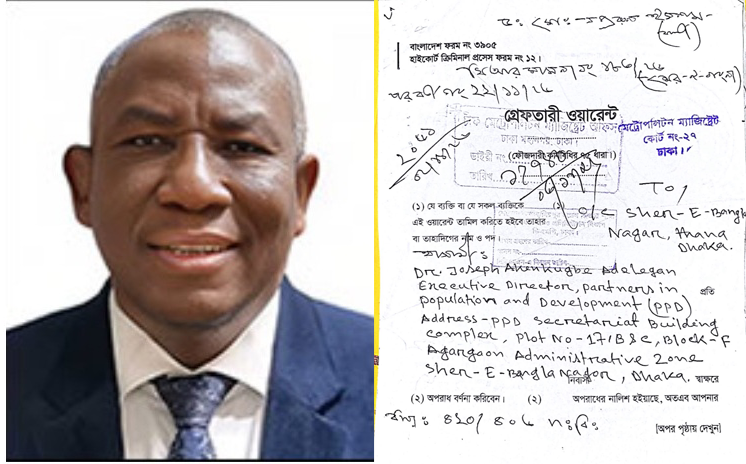
Dhaka Court Issues Arrest Warrant, Travel Ban for PPD Executive Director Prof. Joseph Akinkugbe Adelegan

Reporter Name
  • Update Time : 02:12:49 pm, Saturday, 14 November 2026
  • / 11 Time View

Prof. Joseph Akinkugbe Adelegan, a Nigerian national, faces criminal allegations involving financial misconduct amid scrutiny over staff dismissals, workplace harassment, institutional governance and the organisation’s legal status in Bangladesh.

A Dhaka Metropolitan Magistrate Court has ordered the issuance of an arrest warrant against Prof. Joseph Akinkugbe Adelegan, Executive Director of the Dhaka-based Partners in Population and Development (PPD), following a criminal complaint involving allegations of financial misconduct and misuse of organisational funds.

Court records indicate that the arrest-warrant order was issued on October 26, 2026. In a subsequent order on November 1, 2026, the court directed the Immigration Administration of Bangladesh Police to take necessary legal measures to prevent Prof. Joseph Akinkugbe Adelegan from leaving the country without prior judicial permission.

The criminal case, numbered C.R. 183/2026, was filed by a former senior PPD official. The magistrate took cognisance against Adelegan under Sections 406 and 420 of the Penal Code, concerning criminal breach of trust and cheating.

According to the complaint, Adelegan, who assumed leadership of PPD in October 2025, is accused of financial misconduct and mismanagement of institutional resources. Separate complaints have also raised allegations of unlawful dismissals, workplace harassment and intimidation, withholding of salaries and medical reimbursements, and irregularities involving recruitment, promotions and foreign travel.

The allegations remain subject to judicial proceedings and have not been established as criminal wrongdoing. Adelegan was subsequently reported to have appeared before the court on November 19. Any further decision concerning the warrant or travel restriction requires confirmation from the latest judicial records.

An estimated 45% of PPD’s organisational income reportedly derives from Bangladesh government contributions and rental income from the PPD building, while approximately 35% comes from China and the remaining 20% from other member countries. These reported figures have raised questions about financial accountability and the responsibility of member governments to ensure proper oversight.

Legal Status and Claimed Privileges Under Scrutiny

Beyond the criminal allegations, the controversy has cast a spotlight on PPD’s legal standing in Bangladesh and the validity of diplomatic privileges and immunities claimed by its leadership.

A United Nations Population Fund (UNFPA) background framework shows that PPD’s Secretariat was established in Dhaka in 1996 as a UNDP/UNFPA-funded project to advance the 1994 International Conference on Population and Development (ICPD) Programme of Action across ten member countries. Under a 1996 Memorandum of Understanding (MoU) signed between the Government of Bangladesh, represented by the Ministry of Health, and PPD, international personnel appointed by UNFPA were granted customary UN-equivalent privileges and immunities strictly within the scope of that project.

However, available governance records confirm that the 1996 MoU ceased to apply when PPD separated from UNDP/UNFPA and became an independent entity in 2001. Since that transition, PPD has continued operating in Dhaka without executing a subsequent Host Country Agreement with the Ministry of Health and Family Welfare (MoHFW) or obtaining mandatory registration from the NGO Affairs Bureau (NGOAB).

Observers and governance documents indicate that this two-decade regulatory vacuum left the organisation without legally binding host-country oversight. Internal accounts allege that local staff members who raised concerns over financial irregularities or pushed for formal legal registration and UN-standard accountability rules faced retaliatory dismissal, causing institutional reforms to stall.

Absence of Statutory Tax Exemption or Treaty Immunity

While PPD’s By-Laws describe the body as an intergovernmental organisation, legal experts note that acquiring intergovernmental status and exercising diplomatic immunities in Bangladesh requires domestic legislation or a ratified Host Country Agreement, a prerequisite explicitly referenced under Article 14 of the 1996 MoU. Minutes from PPD’s 1995 Executive Committee meeting in New York (Agenda Item 3: “Financial and Legal Status of Partners”) show that leadership had directed the interim Secretariat and UNFPA to consult legal specialists and prepare options for international legal registration by November 1995, a process never completed in Bangladesh.

Questions have also been raised concerning PPD’s tax treatment and diplomatic status. Although the Ministry of Foreign Affairs reportedly issued correspondence in 2003 referring to PPD’s inclusion in a diplomatic corps listing, available records suggest that the correspondence related only to a preliminary inquiry about tax treatment, made as the organisation transitioned away from the UNDP/UNFPA funding arrangement.

Crucially, the National Board of Revenue (NBR) has reportedly never issued a Statutory Regulatory Order (SRO) granting PPD tax-exempt status. Under Bangladeshi law, tax exemptions and diplomatic immunities cannot be established through informal correspondence; they require clear statutory authority, a valid SRO, or a Cabinet-approved bilateral agreement.

A comparative review of international instruments, including the Convention on the Privileges and Immunities of the United Nations 1946 and the UN-US Department of State Agreement, alongside PPD’s own Charter, By-Laws, employment contract, and recruitment advertisements reveals no provision granting diplomatic immunity to the Executive Director of PPD.

Diplomatic Status or Ordinary Professional?

The court’s arrest warrant and travel ban have also prompted calls for the Ministry of Foreign Affairs to clarify the basis on which Prof. Joseph Akinkugbe Adelegan obtained a diplomatic-type visa or residence status in Bangladesh.

Under established international protocol and the Vienna Convention on Diplomatic Relations (1961), immunity from a host country’s criminal and civil jurisdiction is reserved for officially accredited diplomats representing a sending state or recognised international civil servants covered by a ratified treaty.

Mere administrative registration or inclusion on a liaison list does not confer diplomatic immunity upon an individual recruited through an ordinary professional hiring process.

The privileges and immunities of United Nations officials, experts on mission, and representatives of Member States to the UN arise under the applicable provisions of the Convention on the Privileges and Immunities of the United Nations 1946 and, where relevant, other applicable agreements and arrangements. The Convention 1946 does not automatically confer the status of a UN official or diplomatic representative on personnel of an independent organisation. Any claim that a PPD employee is entitled to such privileges or immunities should therefore be supported by the specific legal instrument and formal notification applicable to that person.

The relevant UN and host-country records should establish whether any such status was conferred. Because Prof. Joseph Akinkugbe Adelegan serves as a salaried staff member of PPD rather than an accredited state diplomat or UN official, and in the absence of a ratified Host Country Agreement or Cabinet approval, legal observers note that he is not exempt from local court jurisdiction. Consequently, as an ordinary foreign national working in Bangladesh, he remains fully subject to domestic law, judicial warrants, and prosecution.

In addition, the policy documents governing the appointment of PPD’s Executive Director do not provide for diplomatic status. PPD’s By-Laws also indicate that no legally binding arrangement conferring such status has been established between PPD and the Government of Bangladesh through national legislation. Accordingly, the Executive Director’s appointment alone should not be taken as evidence of diplomatic or other special immigration status.

A senior official of Bangladesh’s Ministry of Foreign Affairs has stated that, under the arrangements applicable to PPD, the Executive Director enjoys functional immunity rather than blanket personal immunity from Bangladesh’s legal system.

According to the official, such immunity relates to protected official functions and does not automatically prevent proceedings concerning personal conduct.

The official indicated that the Executive Director would remain answerable to the courts in matters falling outside the scope of any applicable functional immunity.

Governance Crisis and Host-Country Concerns

Documents concerning PPD’s internal administration describe a serious governance dispute involving the Executive Director, Bangladesh as the host country, and members of the organisation’s Board and Executive Committee.

Allegations have been raised that Adelegan challenged Bangladesh’s membership and voting rights, rejected the Host Country Board Member’s supervisory role and sought changes to provisions concerning appointment and dismissal authority.

PPD’s official recruitment advertisement and Executive Director job description identify the Chairperson of the Board as the person to whom the Executive Director reports. They also identify the Host Country Board Member representing Bangladesh as his immediate supervisor.

The dispute intensified after the elected Board Chair called for an independent investigation into allegations concerning the Executive Director’s administration and recommended precautionary measures.

The Chair was subsequently removed from PPD’s official website listing, while another representative was identified as Acting Chair.

Questions have arisen about the governing-body decision authorising that change and whether the procedures for filling a vacancy were followed.

In correspondence circulated to Executive Committee members, the Chair called for the Executive Director’s immediate precautionary suspension pending an independent investigation and requested individual responses from Committee members concerning the reported administrative, financial and ethical irregularities.

The Chair also called upon the Treasurer to address the financial allegations and exercise the responsibilities attached to that office.

Separately, Bangladesh and Pakistan formally challenged an extraordinary Executive Committee meeting proposed by Adelegan for October 10, 2026, in Nairobi.

Pakistan, which holds the Secretary’s position on PPD’s governing bodies, communicated that the proposed physical meeting had been cancelled and that any subsequent meeting should be convened through the prescribed procedure.

Bangladesh similarly questioned the Executive Director’s authority to convene the meeting independently and requested its postponement or cancellation.

Both countries raised concerns about institutional procedures and expenditure on international meetings during a period of financial constraints.

The dispute continued when further invitations were issued for an international inter-ministerial conference on South-South cooperation in Nairobi from November 30 to December 1, followed by Executive Committee and Board meetings through December 4.

A separate invitation dated November 11 was issued by Kenya’s National Council for Population and Development, whose representative holds PPD’s Treasurer position, inviting a representative of the DMUN Foundation to attend the conference and associated governance meetings.

Questions remain about the formal approval of the later governing-body meetings, the role of the elected Secretary and the resolution of Bangladesh’s and Pakistan’s earlier objections.

The Executive Director’s ability to attend the Nairobi programme in person is also affected by the court’s departure restriction unless judicial permission has been granted or the order has subsequently been modified.

If substantiated, the wider governance allegations would raise significant concerns about compliance with PPD’s By-Laws, Board authority, institutional independence and the responsibilities of the host country.

Unauthorised Foreign Representation and Reopening of Closed Offices Using Diplomatic Privilege from Bangladesh (New York and Geneva)

On the sidelines of the 79th World Health Assembly in May 2026, he signed an agreement in principle with the Health Innovation Exchange (HIEx) to establish a representative office in Geneva, reportedly involving an associate of former Executive Director Dr. Joe Thomas. Staff members who questioned the legality of these offices reportedly faced disciplinary retaliation or termination.

In October 2026, PPD also announced the reopening of its Permanent Observer Mission to the United Nations in New York and accepted the nomination of Myelle Mariah Rodgers as Permanent Observer-designate.

Board decisions reportedly adopted during China’s chairmanship in 2017 and 2018 directed the closure of PPD’s foreign missions.

The subsequent initiatives concerning Geneva and New York have therefore raised questions about whether the earlier decisions were formally reversed by the competent governing body.

PPD’s agreement with the South Korea-based DMUN Foundation, which entered into force in September 2026, provided for institutional support connected to proposed representation in New York, Geneva and Vienna.

The Foundation nominated Myelle Mariah Rodgers, a member of its Secretariat, as PPD’s Permanent Observer-designate.

The DMUN Foundation confirmed that it had not received any relevant Board or Executive Committee resolution approving its agreements with Partners in Population and Development (PPD) or the nomination of Ms. Myelle Mariah Rodgers. The Foundation further confirmed that Rodgers had neither been formally appointed nor registered with the United Nations Protocol and Liaison Service. Despite this, PPD’s official website publicly identifies Rodgers as its Permanent Observer to the United Nations, including in its staff listing. This raises serious questions about how a nomination that had not completed the required approval process came to be presented as an official institutional appointment. Under Section 12 of PPD’s By-Laws, UN observers must be appointed by the Executive Committee following Board approval. Who authorised Rodgers’ public designation, which governing-body resolution supports it, and under what authority did the Executive Director’s office announce her appointment before the required approvals and formal UN recognition had been established?

DMUN Foundation stated that it had assessed potential conflicts of interest relating to the proposed secondment and maintained confidence in Rodgers’ professional experience.

The unresolved issue therefore concerns the authority under which the Secretariat accepted the nomination and entered into the arrangements, rather than any assumption that a younger professional is automatically ineligible.

If the relevant Board approvals and financial authorisations were not obtained, the reopening of overseas offices and the appointment arrangements would raise serious questions about compliance with PPD’s governing framework.

Diplomatic privileges or recognition facilitated through Bangladesh would not, by themselves, substitute for institutional approval requirements.

The agreements, appointments, financial commitments and earlier Board resolutions therefore warrant independent examination.

PPD Audit Arrangements Face Questions Over Approval and Oversight

Questions have emerged over the appointment of external auditors and the handling of a separate audit reportedly commissioned by the Host Government, prompting calls for relevant records to be reviewed. Sources allege that Prof. Joseph Akinkugbe Adelegan engaged KPMG to audit PPD’s accounts for the 2022-2025 fiscal years. The engagement reportedly took place amid an audit backlog dating back to 2022 and gaps in relevant policies.

PPD’s policies reportedly reserve authority over the appointment of external auditors, annual budgets, and budget revisions to the Board. People familiar with the organisation’s finances say its annual audit budget is typically below US$3,000. They estimate that auditing four years of accounts could cost US$10,000 to US$12,000 under standard procurement practices. These estimates should be checked against the relevant budgets and procurement records.

PPD’s own published statement confirms that KPMG was engaged for a professional fee of US$22,000, against a budget allocation of US$23,000. However, Chapter XVII, Section 4 of PPD’s Finance Manual assigns the appointment of annual external auditors to the Board and requires their selection to follow procurement guidelines. Section 1602(d) of the Administrative Manual requires sealed quotations and prescribed Procurement Committee procedures for procurements exceeding US$15,000. Allegations have emerged that KPMG was appointed without following this mandatory competitive process. Despite requests for clarification, the relevant sealed-bid records, Procurement Committee evaluation and governing-body approval documents have not been produced to establish compliance with these requirements.

Further questions have arisen over a potential conflict of interest involving an individual associated with the KPMG audit who reportedly also applied for PPD’s Head of Finance position. Another serious concern involves the subsequent use of KPMG’s findings against former employees. The affected employees allege that they were neither provided with the final audit report or relevant findings nor given an adequate opportunity to examine and respond to the alleged financial discrepancies before PPD publicly accused them of “serious financial misconduct.” These circumstances raise significant questions about the independence of the audit process, compliance with procurement regulations, the determination of individual financial responsibility and whether proper procedural safeguards were followed before serious allegations were made public.

A separate matter concerns an external audit covering 2021-2024, reportedly conducted by ACNABIN under the supervision of the Host Government. The audit is said to have raised issues involving several staff members, including recruitment evaluation records concerning Anika Hossain and Shamrin Bari. Allegations have also been made that Prof. Joseph Akinkugbe Adelegan improperly promoted three staff members.

The ACNABIN report reportedly has not been approved by the Board, and any findings or proposed actions concerning staff or leadership have not been formally endorsed. The preliminary report was scheduled for discussion at the 40th Executive Committee meeting on November 4, 2025. It is alleged that Prof. Joseph Akinkugbe Adelegan subsequently removed the report from the agenda without the knowledge of the then Board Chair, representing South Africa, or Bangladesh’s host-country representative.

The matter has also drawn attention to PPD’s financial oversight arrangements. The office reportedly operated for several years without a permanent finance manager, while the Executive Director position was vacant and two officers-in-charge served: Mr. Oliver Zambuko of Zimbabwe and Mr. Patrick Murgira of Uganda. Their responsibilities and the financial controls in place during that period have not been confirmed.

The timing of a public notice issued by Prof. Joseph Akinkugbe Adelegan concerning the audit findings, linking them with senior staff and the Board Chair, has raised further questions about process and the Executive Director’s authority to act without Board approval.

A Decade of Recurring Governance Vulnerabilities (2016–2025)

Governance analysts and former officials note that the current crisis reflects a decade-long pattern of institutional vulnerability stemming from PPD’s lack of a formal Host Country Agreement in Bangladesh.

In 2016, former Executive Director Dr. Joe Thomas drew scrutiny after reportedly leveraging unverified diplomatic status in an unsuccessful bid for the post of World Health Organization (WHO) Director-General, as reported by Prothom Alo on August 16, 2016. Two years later, on July 29, 2018, China’s Government Commissioner, Dr. Hu Hongtao, formally wrote to Bangladesh’s Ministry of Foreign Affairs seeking intervention over the alleged misappropriation of Chinese construction donations and Indian project funds during Dr. Thomas’s tenure.

Subsequently, another former Executive Director, Mr. Adnene Ben Haj Aissa, resigned in May 2022 following formal complaints of workplace harassment and financial misconduct lodged by PPD’s then Finance Manager, prompting written intervention from the South African Board Chair to Dhaka.

Analysts say the recurring controversies underscore urgent calls from governance experts for the Ministries of Health and Family Welfare and Foreign Affairs to regularise PPD’s legal standing, either through a ratified Host Country Agreement or mandatory registration under the NGO Affairs Bureau, to ensure transparency and protect public funds.

Investigation Raises Questions Over PPD Leadership, Staff Treatment, and Use of Funds

The recent developments raise serious questions concerning allegations of unlawful dismissals, workplace harassment and intimidation, irregularities in recruitment and promotions, foreign-travel spending, and the possible misuse of institutional resources.

At the centre of the controversy is a dispute over the Executive Director’s interpretation of institutional authority and diplomatic privileges.

PPD’s governing documents establish responsibilities for its Board, Executive Committee, Treasurer and senior management. Those responsibilities cannot be displaced solely by an assertion that a particular decision was taken under the Executive Director’s administrative authority.

The handling of staff complaints and disciplinary proceedings has also attracted scrutiny.

Former employees have submitted dismissal appeals and workplace-harassment complaints to PPD’s Executive Committee, with questions remaining over their independent examination and resolution.

Separate complaints have been raised about changes to personnel procedures and the formation of disciplinary panels involving staff who had previously challenged the Executive Director’s conduct.

The relevant issue is whether the competent governing bodies approved those procedures and whether the disciplinary arrangements provided sufficient independence and opportunities for employees to respond.

Concerns have also emerged from a recently recruited international senior official who subsequently left PPD and submitted a formal institutional grievance.

The grievance raised allegations concerning management conduct, workplace intimidation, performance-appraisal procedures, staff treatment and the influence of employees attached to the Executive Office.

It also described concerns about the organisation’s deteriorating relationship with Bangladesh and the resulting difficulties involving work permits and administrative arrangements for foreign personnel.

The former official questioned whether complaints against the Executive Director’s immediate staff were being addressed through genuinely independent procedures.

The grievance and the Executive Office’s response contain competing accounts that require an impartial examination of the underlying correspondence and workplace records.

Questions Concerning Anika Hossain and Humayun Kabir Shishir

Particular questions have arisen over the positions, responsibilities and authority exercised by Anika Hossain and Khandaker Humayun Kabir Shishir within the PPD Secretariat.

Hossain, who previously served in a programme-related position, subsequently worked as Executive Assistant to the Executive Director.

Bangladesh’s Ministry of Health and Family Welfare had earlier raised concerns about her conduct in circulating allegations involving PPD personnel outside the organisation’s prescribed procedures and requested disciplinary consideration.

The earlier government correspondence predates Adelegan’s appointment.

Questions remain about how the complaint was addressed and whether subsequent changes in Hossain’s position, responsibilities or employment grade received the required institutional approvals.

In a later dispute, an international senior official alleged that Hossain became involved in matters concerning the appraisal, probationary confirmation and contractual treatment of employees outside her direct reporting responsibilities.

Anika Hossain issued a written response disputing the allegations and raising concerns about the complainant’s professional conduct.

The former employee rejected those allegations and requested independent scrutiny of the Executive Office’s involvement in personnel decisions.

The disagreement raises questions about the precise authority delegated to the Executive Assistant and whether established supervisory relationships were respected.

Separately, concerns have been raised about Humayun Kabir Shishir’s contractual arrangements, extension of service, restoration of responsibilities and subsequent designation as Head of IT and Communications.

PPD has maintained that the relevant restoration of responsibilities received Executive Committee approval.

Nevertheless, the applicable meeting resolutions, employment terms, grade changes and approved organisational structure remain necessary to establish how the decisions complied with PPD’s personnel framework.

The former international senior official’s grievance also named Hossain and Shishir while questioning the influence of a small group of employees over management decisions.

Those statements remain allegations by the complainant and do not constitute independent findings of misconduct against either employee.

Continuing Questions Over Governance and Accountability

The allegations against Adelegan have developed alongside disagreements between member-country representatives, court proceedings, financial-management questions and disputes over staff appointments and international representation.

The elected Chair’s earlier call for precautionary suspension and independent investigation demonstrates that significant concerns were raised within PPD’s governing structure.

Bangladesh and Pakistan’s written objections to the proposed Nairobi meeting further show that disagreements over the Executive Director’s authority extend beyond individual employment complaints.

The subsequent court orders have added a legal dimension to the controversy, while outstanding questions concerning financial approvals, procurement procedures and the treatment of employees remain unresolved.

The central issue is whether decisions concerning institutional expenditure, disciplinary proceedings, staff appointments and overseas representation were taken through the competent governing bodies and in accordance with PPD’s approved rules.

For Bangladesh, the concerns also involve the country’s permanent role in PPD’s governing structure, its responsibilities as host country and the legal protections available to employees working at the Dhaka Secretariat.

The judicial allegations must be determined by the courts. The wider institutional questions require an independent examination of the applicable governing-body resolutions, contracts, financial records, personnel decisions and host-country arrangements.

The outcome will be significant for PPD’s future credibility, the protection of its institutional resources and accountability to its member countries.

Tag :

Please Share This Post in Your Social Media

Write Your Comment

Your email address will not be published. Required fields are marked *

Save Your Email and Others Information

About Author Information

Dhaka Court Issues Arrest Warrant, Travel Ban for PPD Executive Director Prof. Joseph Akinkugbe Adelegan

Update Time : 02:12:49 pm, Saturday, 14 November 2026

Prof. Joseph Akinkugbe Adelegan, a Nigerian national, faces criminal allegations involving financial misconduct amid scrutiny over staff dismissals, workplace harassment, institutional governance and the organisation’s legal status in Bangladesh.

A Dhaka Metropolitan Magistrate Court has ordered the issuance of an arrest warrant against Prof. Joseph Akinkugbe Adelegan, Executive Director of the Dhaka-based Partners in Population and Development (PPD), following a criminal complaint involving allegations of financial misconduct and misuse of organisational funds.

Court records indicate that the arrest-warrant order was issued on October 26, 2026. In a subsequent order on November 1, 2026, the court directed the Immigration Administration of Bangladesh Police to take necessary legal measures to prevent Prof. Joseph Akinkugbe Adelegan from leaving the country without prior judicial permission.

The criminal case, numbered C.R. 183/2026, was filed by a former senior PPD official. The magistrate took cognisance against Adelegan under Sections 406 and 420 of the Penal Code, concerning criminal breach of trust and cheating.

According to the complaint, Adelegan, who assumed leadership of PPD in October 2025, is accused of financial misconduct and mismanagement of institutional resources. Separate complaints have also raised allegations of unlawful dismissals, workplace harassment and intimidation, withholding of salaries and medical reimbursements, and irregularities involving recruitment, promotions and foreign travel.

The allegations remain subject to judicial proceedings and have not been established as criminal wrongdoing. Adelegan was subsequently reported to have appeared before the court on November 19. Any further decision concerning the warrant or travel restriction requires confirmation from the latest judicial records.

An estimated 45% of PPD’s organisational income reportedly derives from Bangladesh government contributions and rental income from the PPD building, while approximately 35% comes from China and the remaining 20% from other member countries. These reported figures have raised questions about financial accountability and the responsibility of member governments to ensure proper oversight.

Legal Status and Claimed Privileges Under Scrutiny

Beyond the criminal allegations, the controversy has cast a spotlight on PPD’s legal standing in Bangladesh and the validity of diplomatic privileges and immunities claimed by its leadership.

A United Nations Population Fund (UNFPA) background framework shows that PPD’s Secretariat was established in Dhaka in 1996 as a UNDP/UNFPA-funded project to advance the 1994 International Conference on Population and Development (ICPD) Programme of Action across ten member countries. Under a 1996 Memorandum of Understanding (MoU) signed between the Government of Bangladesh, represented by the Ministry of Health, and PPD, international personnel appointed by UNFPA were granted customary UN-equivalent privileges and immunities strictly within the scope of that project.

However, available governance records confirm that the 1996 MoU ceased to apply when PPD separated from UNDP/UNFPA and became an independent entity in 2001. Since that transition, PPD has continued operating in Dhaka without executing a subsequent Host Country Agreement with the Ministry of Health and Family Welfare (MoHFW) or obtaining mandatory registration from the NGO Affairs Bureau (NGOAB).

Observers and governance documents indicate that this two-decade regulatory vacuum left the organisation without legally binding host-country oversight. Internal accounts allege that local staff members who raised concerns over financial irregularities or pushed for formal legal registration and UN-standard accountability rules faced retaliatory dismissal, causing institutional reforms to stall.

Absence of Statutory Tax Exemption or Treaty Immunity

While PPD’s By-Laws describe the body as an intergovernmental organisation, legal experts note that acquiring intergovernmental status and exercising diplomatic immunities in Bangladesh requires domestic legislation or a ratified Host Country Agreement, a prerequisite explicitly referenced under Article 14 of the 1996 MoU. Minutes from PPD’s 1995 Executive Committee meeting in New York (Agenda Item 3: “Financial and Legal Status of Partners”) show that leadership had directed the interim Secretariat and UNFPA to consult legal specialists and prepare options for international legal registration by November 1995, a process never completed in Bangladesh.

Questions have also been raised concerning PPD’s tax treatment and diplomatic status. Although the Ministry of Foreign Affairs reportedly issued correspondence in 2003 referring to PPD’s inclusion in a diplomatic corps listing, available records suggest that the correspondence related only to a preliminary inquiry about tax treatment, made as the organisation transitioned away from the UNDP/UNFPA funding arrangement.

Crucially, the National Board of Revenue (NBR) has reportedly never issued a Statutory Regulatory Order (SRO) granting PPD tax-exempt status. Under Bangladeshi law, tax exemptions and diplomatic immunities cannot be established through informal correspondence; they require clear statutory authority, a valid SRO, or a Cabinet-approved bilateral agreement.

A comparative review of international instruments, including the Convention on the Privileges and Immunities of the United Nations 1946 and the UN-US Department of State Agreement, alongside PPD’s own Charter, By-Laws, employment contract, and recruitment advertisements reveals no provision granting diplomatic immunity to the Executive Director of PPD.

Diplomatic Status or Ordinary Professional?

The court’s arrest warrant and travel ban have also prompted calls for the Ministry of Foreign Affairs to clarify the basis on which Prof. Joseph Akinkugbe Adelegan obtained a diplomatic-type visa or residence status in Bangladesh.

Under established international protocol and the Vienna Convention on Diplomatic Relations (1961), immunity from a host country’s criminal and civil jurisdiction is reserved for officially accredited diplomats representing a sending state or recognised international civil servants covered by a ratified treaty.

Mere administrative registration or inclusion on a liaison list does not confer diplomatic immunity upon an individual recruited through an ordinary professional hiring process.

The privileges and immunities of United Nations officials, experts on mission, and representatives of Member States to the UN arise under the applicable provisions of the Convention on the Privileges and Immunities of the United Nations 1946 and, where relevant, other applicable agreements and arrangements. The Convention 1946 does not automatically confer the status of a UN official or diplomatic representative on personnel of an independent organisation. Any claim that a PPD employee is entitled to such privileges or immunities should therefore be supported by the specific legal instrument and formal notification applicable to that person.

The relevant UN and host-country records should establish whether any such status was conferred. Because Prof. Joseph Akinkugbe Adelegan serves as a salaried staff member of PPD rather than an accredited state diplomat or UN official, and in the absence of a ratified Host Country Agreement or Cabinet approval, legal observers note that he is not exempt from local court jurisdiction. Consequently, as an ordinary foreign national working in Bangladesh, he remains fully subject to domestic law, judicial warrants, and prosecution.

In addition, the policy documents governing the appointment of PPD’s Executive Director do not provide for diplomatic status. PPD’s By-Laws also indicate that no legally binding arrangement conferring such status has been established between PPD and the Government of Bangladesh through national legislation. Accordingly, the Executive Director’s appointment alone should not be taken as evidence of diplomatic or other special immigration status.

A senior official of Bangladesh’s Ministry of Foreign Affairs has stated that, under the arrangements applicable to PPD, the Executive Director enjoys functional immunity rather than blanket personal immunity from Bangladesh’s legal system.

According to the official, such immunity relates to protected official functions and does not automatically prevent proceedings concerning personal conduct.

The official indicated that the Executive Director would remain answerable to the courts in matters falling outside the scope of any applicable functional immunity.

Governance Crisis and Host-Country Concerns

Documents concerning PPD’s internal administration describe a serious governance dispute involving the Executive Director, Bangladesh as the host country, and members of the organisation’s Board and Executive Committee.

Allegations have been raised that Adelegan challenged Bangladesh’s membership and voting rights, rejected the Host Country Board Member’s supervisory role and sought changes to provisions concerning appointment and dismissal authority.

PPD’s official recruitment advertisement and Executive Director job description identify the Chairperson of the Board as the person to whom the Executive Director reports. They also identify the Host Country Board Member representing Bangladesh as his immediate supervisor.

The dispute intensified after the elected Board Chair called for an independent investigation into allegations concerning the Executive Director’s administration and recommended precautionary measures.

The Chair was subsequently removed from PPD’s official website listing, while another representative was identified as Acting Chair.

Questions have arisen about the governing-body decision authorising that change and whether the procedures for filling a vacancy were followed.

In correspondence circulated to Executive Committee members, the Chair called for the Executive Director’s immediate precautionary suspension pending an independent investigation and requested individual responses from Committee members concerning the reported administrative, financial and ethical irregularities.

The Chair also called upon the Treasurer to address the financial allegations and exercise the responsibilities attached to that office.

Separately, Bangladesh and Pakistan formally challenged an extraordinary Executive Committee meeting proposed by Adelegan for October 10, 2026, in Nairobi.

Pakistan, which holds the Secretary’s position on PPD’s governing bodies, communicated that the proposed physical meeting had been cancelled and that any subsequent meeting should be convened through the prescribed procedure.

Bangladesh similarly questioned the Executive Director’s authority to convene the meeting independently and requested its postponement or cancellation.

Both countries raised concerns about institutional procedures and expenditure on international meetings during a period of financial constraints.

The dispute continued when further invitations were issued for an international inter-ministerial conference on South-South cooperation in Nairobi from November 30 to December 1, followed by Executive Committee and Board meetings through December 4.

A separate invitation dated November 11 was issued by Kenya’s National Council for Population and Development, whose representative holds PPD’s Treasurer position, inviting a representative of the DMUN Foundation to attend the conference and associated governance meetings.

Questions remain about the formal approval of the later governing-body meetings, the role of the elected Secretary and the resolution of Bangladesh’s and Pakistan’s earlier objections.

The Executive Director’s ability to attend the Nairobi programme in person is also affected by the court’s departure restriction unless judicial permission has been granted or the order has subsequently been modified.

If substantiated, the wider governance allegations would raise significant concerns about compliance with PPD’s By-Laws, Board authority, institutional independence and the responsibilities of the host country.

Unauthorised Foreign Representation and Reopening of Closed Offices Using Diplomatic Privilege from Bangladesh (New York and Geneva)

On the sidelines of the 79th World Health Assembly in May 2026, he signed an agreement in principle with the Health Innovation Exchange (HIEx) to establish a representative office in Geneva, reportedly involving an associate of former Executive Director Dr. Joe Thomas. Staff members who questioned the legality of these offices reportedly faced disciplinary retaliation or termination.

In October 2026, PPD also announced the reopening of its Permanent Observer Mission to the United Nations in New York and accepted the nomination of Myelle Mariah Rodgers as Permanent Observer-designate.

Board decisions reportedly adopted during China’s chairmanship in 2017 and 2018 directed the closure of PPD’s foreign missions.

The subsequent initiatives concerning Geneva and New York have therefore raised questions about whether the earlier decisions were formally reversed by the competent governing body.

PPD’s agreement with the South Korea-based DMUN Foundation, which entered into force in September 2026, provided for institutional support connected to proposed representation in New York, Geneva and Vienna.

The Foundation nominated Myelle Mariah Rodgers, a member of its Secretariat, as PPD’s Permanent Observer-designate.

The DMUN Foundation confirmed that it had not received any relevant Board or Executive Committee resolution approving its agreements with Partners in Population and Development (PPD) or the nomination of Ms. Myelle Mariah Rodgers. The Foundation further confirmed that Rodgers had neither been formally appointed nor registered with the United Nations Protocol and Liaison Service. Despite this, PPD’s official website publicly identifies Rodgers as its Permanent Observer to the United Nations, including in its staff listing. This raises serious questions about how a nomination that had not completed the required approval process came to be presented as an official institutional appointment. Under Section 12 of PPD’s By-Laws, UN observers must be appointed by the Executive Committee following Board approval. Who authorised Rodgers’ public designation, which governing-body resolution supports it, and under what authority did the Executive Director’s office announce her appointment before the required approvals and formal UN recognition had been established?

DMUN Foundation stated that it had assessed potential conflicts of interest relating to the proposed secondment and maintained confidence in Rodgers’ professional experience.

The unresolved issue therefore concerns the authority under which the Secretariat accepted the nomination and entered into the arrangements, rather than any assumption that a younger professional is automatically ineligible.

If the relevant Board approvals and financial authorisations were not obtained, the reopening of overseas offices and the appointment arrangements would raise serious questions about compliance with PPD’s governing framework.

Diplomatic privileges or recognition facilitated through Bangladesh would not, by themselves, substitute for institutional approval requirements.

The agreements, appointments, financial commitments and earlier Board resolutions therefore warrant independent examination.

PPD Audit Arrangements Face Questions Over Approval and Oversight

Questions have emerged over the appointment of external auditors and the handling of a separate audit reportedly commissioned by the Host Government, prompting calls for relevant records to be reviewed. Sources allege that Prof. Joseph Akinkugbe Adelegan engaged KPMG to audit PPD’s accounts for the 2022-2025 fiscal years. The engagement reportedly took place amid an audit backlog dating back to 2022 and gaps in relevant policies.

PPD’s policies reportedly reserve authority over the appointment of external auditors, annual budgets, and budget revisions to the Board. People familiar with the organisation’s finances say its annual audit budget is typically below US$3,000. They estimate that auditing four years of accounts could cost US$10,000 to US$12,000 under standard procurement practices. These estimates should be checked against the relevant budgets and procurement records.

PPD’s own published statement confirms that KPMG was engaged for a professional fee of US$22,000, against a budget allocation of US$23,000. However, Chapter XVII, Section 4 of PPD’s Finance Manual assigns the appointment of annual external auditors to the Board and requires their selection to follow procurement guidelines. Section 1602(d) of the Administrative Manual requires sealed quotations and prescribed Procurement Committee procedures for procurements exceeding US$15,000. Allegations have emerged that KPMG was appointed without following this mandatory competitive process. Despite requests for clarification, the relevant sealed-bid records, Procurement Committee evaluation and governing-body approval documents have not been produced to establish compliance with these requirements.

Further questions have arisen over a potential conflict of interest involving an individual associated with the KPMG audit who reportedly also applied for PPD’s Head of Finance position. Another serious concern involves the subsequent use of KPMG’s findings against former employees. The affected employees allege that they were neither provided with the final audit report or relevant findings nor given an adequate opportunity to examine and respond to the alleged financial discrepancies before PPD publicly accused them of “serious financial misconduct.” These circumstances raise significant questions about the independence of the audit process, compliance with procurement regulations, the determination of individual financial responsibility and whether proper procedural safeguards were followed before serious allegations were made public.

A separate matter concerns an external audit covering 2021-2024, reportedly conducted by ACNABIN under the supervision of the Host Government. The audit is said to have raised issues involving several staff members, including recruitment evaluation records concerning Anika Hossain and Shamrin Bari. Allegations have also been made that Prof. Joseph Akinkugbe Adelegan improperly promoted three staff members.

The ACNABIN report reportedly has not been approved by the Board, and any findings or proposed actions concerning staff or leadership have not been formally endorsed. The preliminary report was scheduled for discussion at the 40th Executive Committee meeting on November 4, 2025. It is alleged that Prof. Joseph Akinkugbe Adelegan subsequently removed the report from the agenda without the knowledge of the then Board Chair, representing South Africa, or Bangladesh’s host-country representative.

The matter has also drawn attention to PPD’s financial oversight arrangements. The office reportedly operated for several years without a permanent finance manager, while the Executive Director position was vacant and two officers-in-charge served: Mr. Oliver Zambuko of Zimbabwe and Mr. Patrick Murgira of Uganda. Their responsibilities and the financial controls in place during that period have not been confirmed.

The timing of a public notice issued by Prof. Joseph Akinkugbe Adelegan concerning the audit findings, linking them with senior staff and the Board Chair, has raised further questions about process and the Executive Director’s authority to act without Board approval.

A Decade of Recurring Governance Vulnerabilities (2016–2025)

Governance analysts and former officials note that the current crisis reflects a decade-long pattern of institutional vulnerability stemming from PPD’s lack of a formal Host Country Agreement in Bangladesh.

In 2016, former Executive Director Dr. Joe Thomas drew scrutiny after reportedly leveraging unverified diplomatic status in an unsuccessful bid for the post of World Health Organization (WHO) Director-General, as reported by Prothom Alo on August 16, 2016. Two years later, on July 29, 2018, China’s Government Commissioner, Dr. Hu Hongtao, formally wrote to Bangladesh’s Ministry of Foreign Affairs seeking intervention over the alleged misappropriation of Chinese construction donations and Indian project funds during Dr. Thomas’s tenure.

Subsequently, another former Executive Director, Mr. Adnene Ben Haj Aissa, resigned in May 2022 following formal complaints of workplace harassment and financial misconduct lodged by PPD’s then Finance Manager, prompting written intervention from the South African Board Chair to Dhaka.

Analysts say the recurring controversies underscore urgent calls from governance experts for the Ministries of Health and Family Welfare and Foreign Affairs to regularise PPD’s legal standing, either through a ratified Host Country Agreement or mandatory registration under the NGO Affairs Bureau, to ensure transparency and protect public funds.

Investigation Raises Questions Over PPD Leadership, Staff Treatment, and Use of Funds

The recent developments raise serious questions concerning allegations of unlawful dismissals, workplace harassment and intimidation, irregularities in recruitment and promotions, foreign-travel spending, and the possible misuse of institutional resources.

At the centre of the controversy is a dispute over the Executive Director’s interpretation of institutional authority and diplomatic privileges.

PPD’s governing documents establish responsibilities for its Board, Executive Committee, Treasurer and senior management. Those responsibilities cannot be displaced solely by an assertion that a particular decision was taken under the Executive Director’s administrative authority.

The handling of staff complaints and disciplinary proceedings has also attracted scrutiny.

Former employees have submitted dismissal appeals and workplace-harassment complaints to PPD’s Executive Committee, with questions remaining over their independent examination and resolution.

Separate complaints have been raised about changes to personnel procedures and the formation of disciplinary panels involving staff who had previously challenged the Executive Director’s conduct.

The relevant issue is whether the competent governing bodies approved those procedures and whether the disciplinary arrangements provided sufficient independence and opportunities for employees to respond.

Concerns have also emerged from a recently recruited international senior official who subsequently left PPD and submitted a formal institutional grievance.

The grievance raised allegations concerning management conduct, workplace intimidation, performance-appraisal procedures, staff treatment and the influence of employees attached to the Executive Office.

It also described concerns about the organisation’s deteriorating relationship with Bangladesh and the resulting difficulties involving work permits and administrative arrangements for foreign personnel.

The former official questioned whether complaints against the Executive Director’s immediate staff were being addressed through genuinely independent procedures.

The grievance and the Executive Office’s response contain competing accounts that require an impartial examination of the underlying correspondence and workplace records.

Questions Concerning Anika Hossain and Humayun Kabir Shishir

Particular questions have arisen over the positions, responsibilities and authority exercised by Anika Hossain and Khandaker Humayun Kabir Shishir within the PPD Secretariat.

Hossain, who previously served in a programme-related position, subsequently worked as Executive Assistant to the Executive Director.

Bangladesh’s Ministry of Health and Family Welfare had earlier raised concerns about her conduct in circulating allegations involving PPD personnel outside the organisation’s prescribed procedures and requested disciplinary consideration.

The earlier government correspondence predates Adelegan’s appointment.

Questions remain about how the complaint was addressed and whether subsequent changes in Hossain’s position, responsibilities or employment grade received the required institutional approvals.

In a later dispute, an international senior official alleged that Hossain became involved in matters concerning the appraisal, probationary confirmation and contractual treatment of employees outside her direct reporting responsibilities.

Anika Hossain issued a written response disputing the allegations and raising concerns about the complainant’s professional conduct.

The former employee rejected those allegations and requested independent scrutiny of the Executive Office’s involvement in personnel decisions.

The disagreement raises questions about the precise authority delegated to the Executive Assistant and whether established supervisory relationships were respected.

Separately, concerns have been raised about Humayun Kabir Shishir’s contractual arrangements, extension of service, restoration of responsibilities and subsequent designation as Head of IT and Communications.

PPD has maintained that the relevant restoration of responsibilities received Executive Committee approval.

Nevertheless, the applicable meeting resolutions, employment terms, grade changes and approved organisational structure remain necessary to establish how the decisions complied with PPD’s personnel framework.

The former international senior official’s grievance also named Hossain and Shishir while questioning the influence of a small group of employees over management decisions.

Those statements remain allegations by the complainant and do not constitute independent findings of misconduct against either employee.

Continuing Questions Over Governance and Accountability

The allegations against Adelegan have developed alongside disagreements between member-country representatives, court proceedings, financial-management questions and disputes over staff appointments and international representation.

The elected Chair’s earlier call for precautionary suspension and independent investigation demonstrates that significant concerns were raised within PPD’s governing structure.

Bangladesh and Pakistan’s written objections to the proposed Nairobi meeting further show that disagreements over the Executive Director’s authority extend beyond individual employment complaints.

The subsequent court orders have added a legal dimension to the controversy, while outstanding questions concerning financial approvals, procurement procedures and the treatment of employees remain unresolved.

The central issue is whether decisions concerning institutional expenditure, disciplinary proceedings, staff appointments and overseas representation were taken through the competent governing bodies and in accordance with PPD’s approved rules.

For Bangladesh, the concerns also involve the country’s permanent role in PPD’s governing structure, its responsibilities as host country and the legal protections available to employees working at the Dhaka Secretariat.

The judicial allegations must be determined by the courts. The wider institutional questions require an independent examination of the applicable governing-body resolutions, contracts, financial records, personnel decisions and host-country arrangements.

The outcome will be significant for PPD’s future credibility, the protection of its institutional resources and accountability to its member countries.