Dhaka 1:54 am, Wednesday, 25 November 2026

Is PPD Defending Joseph Akinkugbe Adelegan’s Personal Interests Amid Criminal Proceedings?

Desk Report
  • Update Time : 06:13:14 pm, Tuesday, 24 November 2026
  • / 22 Time View
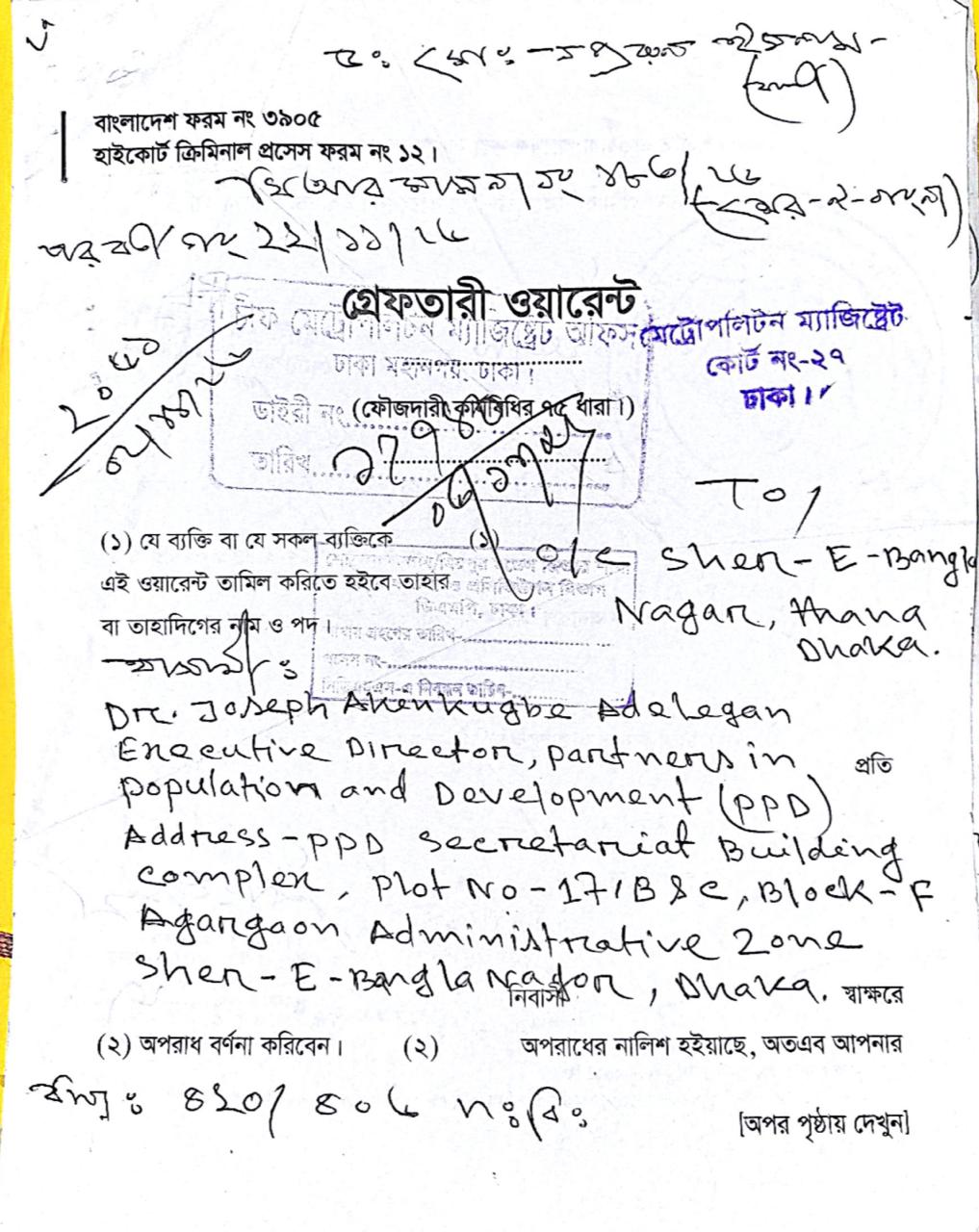
Why does Professor Dr Joseph Akinkugbe Adelegan continue to wield executive authority at Partners in Population and Development (PPD) despite an active arrest warrant, an enforced travel ban, and repeated calls for an independent investigation into his administration?
That question has grown increasingly difficult for the organisation’s governing bodies to sidestep after Bangladesh’s immigration police barred the Nigerian executive director from leaving the country on 22 November.
Instead of offering a transparent accounting of the judicial proceedings and the Board’s response, PPD has issued official statements challenging media reports about Adelegan while defending decisions tied to his administration, financial management, and claimed diplomatic privileges.


This sequence raises a fundamental governance question: Is PPD exercising its institutional authority to safeguard the organisation’s mission, or are its official channels being deployed to shield the personal legal and reputational interests of its chief executive? For a 28-member intergovernmental body entrusted with international development mandates and governed by sovereign member states, maintaining a clear boundary between the two is critical.
 

Arrest Warrant, Travel Restriction and Airport Confrontation

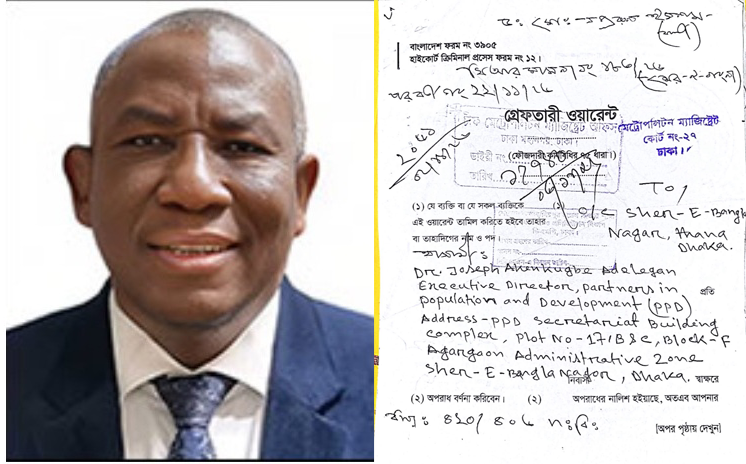
Criminal proceedings against Adelegan stem from C.R. Case No. 183/2026, filed by former senior PPD official Dr Md Nazrul Islam. On 26 October 2026, Dhaka Metropolitan Magistrate Court No. 27 took cognisance of allegations involving criminal breach of trust and cheating under Sections 406 and 420 of the Bangladesh Penal Code and issued a warrant for his arrest. Days later, on 1 November, Metropolitan Magistrate Md Ismail issued a follow-up order instructing Bangladesh Police’s Special Branch immigration authorities to bar Adelegan from departing the country without prior judicial permission.


Despite the binding travel restriction, Adelegan attempted to leave Bangladesh on 22 November aboard Ethiopian Airlines flight ET681, bound for Addis Ababa. Immigration police intercepted him at Hazrat Shahjalal International Airport and offloaded him from the aircraft—an enforcement action later confirmed by an additional superintendent of police attached to airport immigration and widely reported across several Bangladeshi publications.


Accounts of the airport encounter have also triggered fresh scrutiny regarding Adelegan’s conduct. According to a senior Special Branch immigration official speaking on condition of anonymity, Adelegan behaved aggressively toward officers, refused to comply with instructions, and repeatedly challenged their authority. The official alleged that immigration staff temporarily detained him while bringing the situation under control, before eventually allowing him to leave the airport after he signed a written undertaking (muchleka).


The same official further claimed that airport CCTV cameras captured the confrontation and that a detailed report documenting his alleged conduct had been forwarded to senior Special Branch authorities for review and potential action. While those specific claims regarding his demeanour, temporary detention, written undertaking, and CCTV footage still require independent verification through official records, the physical enforcement of the court-ordered travel ban preventing his departure is firmly established. Meanwhile, although Adelegan reportedly appeared in court on 19 November, the outcome of that hearing and the current procedural status of the separate 26 October arrest warrant have yet to be conclusively confirmed through a subsequent certified court order.


PPD’s Public Defence Faces a Credibility Test

PPD’s public relations strategy has come under sharp scrutiny following a pair of paid editorial-page placements used to counter investigative reporting into its leadership. On 21 November, a paid statement from PPD appeared on a newspaper’s editorial page under the headline “PPD Rejects False and Misleading Newspaper Allegations,” which the organisation circulated the next day across its official website and social media channels to defend its stance on pending legal proceedings, financial accountability, diplomatic privileges, and governance.


In that statement, PPD maintained that authenticated copies of certain judicial orders had not been formally served on Adelegan or the organisation. Yet the legal existence of a court order and its formal service are distinct legal questions; a dispute over service does not establish that an order was never issued. Within a day of the placement, immigration police physically enforced the very travel ban PPD’s statement had sought to dismiss, and no subsequent court order revoking that restriction prior to the airport incident has surfaced in PPD’s public responses.


Two days later, on 23 November, a full-page paid communication appeared on a newspaper’s editorial page reproducing institutional press releases dated 15 and 18 November that originated directly from the Office of the Executive Director and Chief Executive Officer. Although editorial-page placements represent the views of the submitting party rather than independent journalism, PPD promoted the paid advertisement as media coverage and framed it to resemble an independent newspaper investigation—standing in stark contrast to the independent reporting by other media outlets that brought allegations of Adelegan’s criminal conduct to light.


Analysts note that Adelegan appears to be passing off paid promotional placements as legitimate news coverage to shield his own personal interests rather than those of the institution, pointing out that the published text directly defends allegations surrounding his personal conduct. This has triggered pressing questions over who authorised these paid publications, whether institutional funds were used to pay for them, and whether the Board independently reviewed and approved their contents. Without any public accounting of the costs and approvals, it remains unclear whether PPD’s publicity and legal expenditures served legitimate organisational purposes or masked a personal conflict of interest.
 

Diplomatic Immunity: A Disputed Legal Foundation

To defend Adelegan’s diplomatic standing, official statements from the secretariat have pointed to a 1996 memorandum of understanding with Bangladesh alongside diplomatic documentation reportedly issued by the Ministry of Foreign Affairs. Yet the precise legal scope of any immunity shield protecting him from personal criminal proceedings remains unresolved.


Founded in 1994 through an international initiative backed by the United Nations Development Programme (UNDP) and the United Nations Population Fund (UNFPA), PPD initially operated its Dhaka Secretariat under project-based arrangements before transitioning into an independent intergovernmental structure. That institutional origin, however, does not automatically confer the status of a United Nations official or an accredited state diplomat upon its executive director.


While Article 14 of PPD’s By-Laws provides for privileges and immunities through applicable national legislation or binding agreements, and Bangladesh’s United Nations (Privileges and Immunities) Act, 1948 allows the government to extend specified protections to international bodies via official notification, the central legal question remains: which specific, legally operative instrument grants Adelegan personal immunity, and does it cover the conduct alleged in the criminal case?


A senior Bangladesh Foreign Ministry official, cited in earlier reporting, clarified that no separate formal Host Country Agreement exists between Bangladesh and PPD. According to the official, while foreign personnel may receive diplomatic-type visas under the 1996 memorandum, such arrangements do not automatically confer blanket personal immunity. The official drew a sharp distinction between functional immunity tied strictly to official duties and individual accountability for personal actions under Bangladeshi law.


PPD’s own Personnel Manual reflects similar boundaries. Section 11203(b) explicitly states that privileges and immunities must not be used to evade private obligations or violations of applicable laws, while Section 11400 outlines mandatory notification procedures when staff members are involved in criminal proceedings. Although these internal rules do not themselves settle questions of international legal immunity—a determination reserved for competent government authorities and the courts—the airport interception has made resolving the scope of Adelegan’s claimed protections an urgent legal priority.

KPMG Appointment and Disputed Financial Findings

Scrutiny of Adelegan’s administration extends well beyond the criminal proceedings. According to official statements from the secretariat, KPMG was hired for US$22,000 to audit PPD’s 2022–2025 accounts following approval from the organisation’s 40th Executive Committee.

However, Chapter XVII, Section 4 of PPD’s Finance Manual assigns the authority to appoint external auditors exclusively to the Board, while Section 1602(d) of the Administrative Manual sets out specific procurement procedures for contracts exceeding US$15,000. Available records do not confirm whether the Board ever separately approved KPMG’s appointment, whether those procurement rules were followed, or whether the Board formally reviewed and accepted the final audit findings.

These procedural gaps carry particular weight because PPD subsequently published institutional notices naming former employees and accusing them of serious financial misconduct. At least one affected staff member had already filed a formal appeal against the disciplinary decision prior to the notice being published. Furthermore, available records do not show whether the named individuals were given the final audit findings, supporting calculations, and a fair opportunity to respond before being publicly identified.

PPD’s Personnel Manual establishes strict rules governing staff confidentiality, disciplinary proceedings, and appeals. An allegation of financial exposure alone does not establish an individual’s personal misconduct or liability; reaching such conclusions requires concrete evidence of personal responsibility alongside a fair process to evaluate the employee’s defence. Ultimately, the central documentary questions remain whether the Board authorised the audit, whether procurement rules were respected, whether the findings were formally accepted, and whether proper procedural safeguards were observed before publishing allegations against former staff.

Salary Increase and Financial Controls

Questions have also been raised over Adelegan’s personal compensation package. While his original employment contract set his annual salary at US$86,163, official statements from the secretariat contend that a revised figure of US$120,000 received proper institutional approval. However, the formal authorisation, contractual amendments, and financial justification supporting that increase remain under scrutiny, alongside questions surrounding additional benefits, accommodation allowances, and international travel expenditure.

Separately, allegations have surfaced that certain financial transactions were processed under a single signature. PPD’s Finance Manual explicitly requires designated financial responsibilities, the segregation of duties, and joint authorisation for bank payments. Verifying whether those controls were followed will require a review of original payment instructions, banking records, and governing-body approvals—unresolved financial questions that reinforce the need for oversight independent of the executive office whose decisions are being examined.

Elected Chair Sought Suspension and Investigation

Concerns surrounding Adelegan’s administration had already reached PPD’s highest governing authorities prior to the airport incident. Professor Mohamed Douagi, the Tunisian representative serving as elected Chair, raised formal questions regarding financial management, administrative decisions, and institutional governance.

In September, Douagi urged the Executive Committee to consider placing Adelegan on precautionary suspension, launching an independent investigation, and implementing safeguards to protect PPD’s accounts and institutional records—a recommendation he reportedly renewed in October. While those proposals sought precautionary steps pending a formal inquiry rather than a declaration of wrongdoing, the publicly available record does not show what formal action, if any, the Executive Committee took on his requests.

Following those calls, a dispute emerged over Douagi’s continuing authority as Chair and the subsequent designation of an Acting Chair. Because PPD’s By-Laws set out specific rules governing elections, vacancies, and governing-body appointments, the legal validity of those leadership changes remains another unresolved issue requiring clarification.

Internal complaints from staff have compounded the governance scrutiny. A senior foreign professional submitted a separate grievance memorandum raising concerns over management conduct, confidentiality, and institutional governance. Meanwhile, a former senior Bangladeshi employee filed a workplace harassment complaint against the executive director shortly before being dismissed, and has since appealed the termination while challenging the independence of the disciplinary process. Both complaints remain contested and require impartial examination.

Bangladesh’s Host-Country Authority Questioned

The escalating controversy has also strained PPD’s relations with its member governments. As the host nation of the organisation’s permanent Secretariat in Dhaka, Bangladesh holds a permanent seat on PPD’s Executive Committee—giving it a direct stake in the institution’s governance.


Previously, both Bangladesh and Pakistan raised objections over the procedures used to convene Executive Committee meetings, questioning whether invitations had been issued by competent office-bearers in accordance with PPD’s By-Laws.


This diplomatic friction comes just ahead of high-level meetings scheduled in Nairobi, Kenya, from 30 November to 4 December, which include a ministerial conference, Executive Committee sessions, and a Board meeting. With a court-ordered travel restriction now actively enforced against him, Adelegan faces practical barriers to attending those gatherings unless granted explicit judicial permission.


Beyond his travel status, deeper governance questions persist regarding the executive director’s current contractual authority, the legitimacy of specific appointments and international representations, and whether decisions requiring Board approval were properly authorised. Ultimately, these issues extend beyond routine internal disputes; they strike at the core authority of the governing institutions overseeing a multilateral body operating from Bangladesh.

Why Does Adelegan Remain in Office?

The central question now confronting PPD’s Board is not whether Adelegan is entitled to defend himself—he is—nor does the existence of criminal proceedings automatically equate to a finding of misconduct or require permanent removal from office. Rather, the issue is whether the Board has independently evaluated the legal, financial, and reputational risks stemming from these allegations and instituted appropriate safeguards.

Despite active court orders, the physical enforcement of a travel restriction, and repeated calls for an independent review of his administration, Adelegan continues to be presented publicly as PPD’s executive director. At the same time, official communications issued through the organization have been used to defend matters directly tied to his personal conduct, remuneration, and legal standing. This overlap creates a fundamental question of institutional accountability that cannot be resolved simply through further statements from the executive office.

To address these concerns, the Board must clearly account for who authorized the legal and publicity expenditures, what independent oversight was conducted, and whether Adelegan’s personal interests were properly separated from organizational decision-making. Documented answers are needed across several unresolved fronts: the current status of the arrest warrant, the precise legal scope of his claimed diplomatic immunity, the approval process behind KPMG’s appointment, the treatment of former employees, disputed financial transactions, and outstanding governance complaints.

Ultimately, PPD’s international standing cannot rest solely on the assurances of an executive director whose own actions and decisions are under scrutiny; its credibility relies on the independence of the governing bodies tasked with holding that office accountable. The enforcement of the court-ordered travel ban on 22 November is an established fact, not a matter of institutional interpretation. How convincingly PPD navigates this leadership crisis will depend on whether its governing bodies respond with independent scrutiny, documented decisions, and robust financial safeguards.


Tag :

Please Share This Post in Your Social Media

Write Your Comment

Your email address will not be published. Required fields are marked *

Save Your Email and Others Information

About Author Information

Is PPD Defending Joseph Akinkugbe Adelegan’s Personal Interests Amid Criminal Proceedings?

Update Time : 06:13:14 pm, Tuesday, 24 November 2026
Why does Professor Dr Joseph Akinkugbe Adelegan continue to wield executive authority at Partners in Population and Development (PPD) despite an active arrest warrant, an enforced travel ban, and repeated calls for an independent investigation into his administration?
That question has grown increasingly difficult for the organisation’s governing bodies to sidestep after Bangladesh’s immigration police barred the Nigerian executive director from leaving the country on 22 November.
Instead of offering a transparent accounting of the judicial proceedings and the Board’s response, PPD has issued official statements challenging media reports about Adelegan while defending decisions tied to his administration, financial management, and claimed diplomatic privileges.


This sequence raises a fundamental governance question: Is PPD exercising its institutional authority to safeguard the organisation’s mission, or are its official channels being deployed to shield the personal legal and reputational interests of its chief executive? For a 28-member intergovernmental body entrusted with international development mandates and governed by sovereign member states, maintaining a clear boundary between the two is critical.
 

Arrest Warrant, Travel Restriction and Airport Confrontation

Criminal proceedings against Adelegan stem from C.R. Case No. 183/2026, filed by former senior PPD official Dr Md Nazrul Islam. On 26 October 2026, Dhaka Metropolitan Magistrate Court No. 27 took cognisance of allegations involving criminal breach of trust and cheating under Sections 406 and 420 of the Bangladesh Penal Code and issued a warrant for his arrest. Days later, on 1 November, Metropolitan Magistrate Md Ismail issued a follow-up order instructing Bangladesh Police’s Special Branch immigration authorities to bar Adelegan from departing the country without prior judicial permission.


Despite the binding travel restriction, Adelegan attempted to leave Bangladesh on 22 November aboard Ethiopian Airlines flight ET681, bound for Addis Ababa. Immigration police intercepted him at Hazrat Shahjalal International Airport and offloaded him from the aircraft—an enforcement action later confirmed by an additional superintendent of police attached to airport immigration and widely reported across several Bangladeshi publications.


Accounts of the airport encounter have also triggered fresh scrutiny regarding Adelegan’s conduct. According to a senior Special Branch immigration official speaking on condition of anonymity, Adelegan behaved aggressively toward officers, refused to comply with instructions, and repeatedly challenged their authority. The official alleged that immigration staff temporarily detained him while bringing the situation under control, before eventually allowing him to leave the airport after he signed a written undertaking (muchleka).


The same official further claimed that airport CCTV cameras captured the confrontation and that a detailed report documenting his alleged conduct had been forwarded to senior Special Branch authorities for review and potential action. While those specific claims regarding his demeanour, temporary detention, written undertaking, and CCTV footage still require independent verification through official records, the physical enforcement of the court-ordered travel ban preventing his departure is firmly established. Meanwhile, although Adelegan reportedly appeared in court on 19 November, the outcome of that hearing and the current procedural status of the separate 26 October arrest warrant have yet to be conclusively confirmed through a subsequent certified court order.


PPD’s Public Defence Faces a Credibility Test

PPD’s public relations strategy has come under sharp scrutiny following a pair of paid editorial-page placements used to counter investigative reporting into its leadership. On 21 November, a paid statement from PPD appeared on a newspaper’s editorial page under the headline “PPD Rejects False and Misleading Newspaper Allegations,” which the organisation circulated the next day across its official website and social media channels to defend its stance on pending legal proceedings, financial accountability, diplomatic privileges, and governance.


In that statement, PPD maintained that authenticated copies of certain judicial orders had not been formally served on Adelegan or the organisation. Yet the legal existence of a court order and its formal service are distinct legal questions; a dispute over service does not establish that an order was never issued. Within a day of the placement, immigration police physically enforced the very travel ban PPD’s statement had sought to dismiss, and no subsequent court order revoking that restriction prior to the airport incident has surfaced in PPD’s public responses.


Two days later, on 23 November, a full-page paid communication appeared on a newspaper’s editorial page reproducing institutional press releases dated 15 and 18 November that originated directly from the Office of the Executive Director and Chief Executive Officer. Although editorial-page placements represent the views of the submitting party rather than independent journalism, PPD promoted the paid advertisement as media coverage and framed it to resemble an independent newspaper investigation—standing in stark contrast to the independent reporting by other media outlets that brought allegations of Adelegan’s criminal conduct to light.


Analysts note that Adelegan appears to be passing off paid promotional placements as legitimate news coverage to shield his own personal interests rather than those of the institution, pointing out that the published text directly defends allegations surrounding his personal conduct. This has triggered pressing questions over who authorised these paid publications, whether institutional funds were used to pay for them, and whether the Board independently reviewed and approved their contents. Without any public accounting of the costs and approvals, it remains unclear whether PPD’s publicity and legal expenditures served legitimate organisational purposes or masked a personal conflict of interest.
 

Diplomatic Immunity: A Disputed Legal Foundation

To defend Adelegan’s diplomatic standing, official statements from the secretariat have pointed to a 1996 memorandum of understanding with Bangladesh alongside diplomatic documentation reportedly issued by the Ministry of Foreign Affairs. Yet the precise legal scope of any immunity shield protecting him from personal criminal proceedings remains unresolved.


Founded in 1994 through an international initiative backed by the United Nations Development Programme (UNDP) and the United Nations Population Fund (UNFPA), PPD initially operated its Dhaka Secretariat under project-based arrangements before transitioning into an independent intergovernmental structure. That institutional origin, however, does not automatically confer the status of a United Nations official or an accredited state diplomat upon its executive director.


While Article 14 of PPD’s By-Laws provides for privileges and immunities through applicable national legislation or binding agreements, and Bangladesh’s United Nations (Privileges and Immunities) Act, 1948 allows the government to extend specified protections to international bodies via official notification, the central legal question remains: which specific, legally operative instrument grants Adelegan personal immunity, and does it cover the conduct alleged in the criminal case?


A senior Bangladesh Foreign Ministry official, cited in earlier reporting, clarified that no separate formal Host Country Agreement exists between Bangladesh and PPD. According to the official, while foreign personnel may receive diplomatic-type visas under the 1996 memorandum, such arrangements do not automatically confer blanket personal immunity. The official drew a sharp distinction between functional immunity tied strictly to official duties and individual accountability for personal actions under Bangladeshi law.


PPD’s own Personnel Manual reflects similar boundaries. Section 11203(b) explicitly states that privileges and immunities must not be used to evade private obligations or violations of applicable laws, while Section 11400 outlines mandatory notification procedures when staff members are involved in criminal proceedings. Although these internal rules do not themselves settle questions of international legal immunity—a determination reserved for competent government authorities and the courts—the airport interception has made resolving the scope of Adelegan’s claimed protections an urgent legal priority.

KPMG Appointment and Disputed Financial Findings

Scrutiny of Adelegan’s administration extends well beyond the criminal proceedings. According to official statements from the secretariat, KPMG was hired for US$22,000 to audit PPD’s 2022–2025 accounts following approval from the organisation’s 40th Executive Committee.

However, Chapter XVII, Section 4 of PPD’s Finance Manual assigns the authority to appoint external auditors exclusively to the Board, while Section 1602(d) of the Administrative Manual sets out specific procurement procedures for contracts exceeding US$15,000. Available records do not confirm whether the Board ever separately approved KPMG’s appointment, whether those procurement rules were followed, or whether the Board formally reviewed and accepted the final audit findings.

These procedural gaps carry particular weight because PPD subsequently published institutional notices naming former employees and accusing them of serious financial misconduct. At least one affected staff member had already filed a formal appeal against the disciplinary decision prior to the notice being published. Furthermore, available records do not show whether the named individuals were given the final audit findings, supporting calculations, and a fair opportunity to respond before being publicly identified.

PPD’s Personnel Manual establishes strict rules governing staff confidentiality, disciplinary proceedings, and appeals. An allegation of financial exposure alone does not establish an individual’s personal misconduct or liability; reaching such conclusions requires concrete evidence of personal responsibility alongside a fair process to evaluate the employee’s defence. Ultimately, the central documentary questions remain whether the Board authorised the audit, whether procurement rules were respected, whether the findings were formally accepted, and whether proper procedural safeguards were observed before publishing allegations against former staff.

Salary Increase and Financial Controls

Questions have also been raised over Adelegan’s personal compensation package. While his original employment contract set his annual salary at US$86,163, official statements from the secretariat contend that a revised figure of US$120,000 received proper institutional approval. However, the formal authorisation, contractual amendments, and financial justification supporting that increase remain under scrutiny, alongside questions surrounding additional benefits, accommodation allowances, and international travel expenditure.

Separately, allegations have surfaced that certain financial transactions were processed under a single signature. PPD’s Finance Manual explicitly requires designated financial responsibilities, the segregation of duties, and joint authorisation for bank payments. Verifying whether those controls were followed will require a review of original payment instructions, banking records, and governing-body approvals—unresolved financial questions that reinforce the need for oversight independent of the executive office whose decisions are being examined.

Elected Chair Sought Suspension and Investigation

Concerns surrounding Adelegan’s administration had already reached PPD’s highest governing authorities prior to the airport incident. Professor Mohamed Douagi, the Tunisian representative serving as elected Chair, raised formal questions regarding financial management, administrative decisions, and institutional governance.

In September, Douagi urged the Executive Committee to consider placing Adelegan on precautionary suspension, launching an independent investigation, and implementing safeguards to protect PPD’s accounts and institutional records—a recommendation he reportedly renewed in October. While those proposals sought precautionary steps pending a formal inquiry rather than a declaration of wrongdoing, the publicly available record does not show what formal action, if any, the Executive Committee took on his requests.

Following those calls, a dispute emerged over Douagi’s continuing authority as Chair and the subsequent designation of an Acting Chair. Because PPD’s By-Laws set out specific rules governing elections, vacancies, and governing-body appointments, the legal validity of those leadership changes remains another unresolved issue requiring clarification.

Internal complaints from staff have compounded the governance scrutiny. A senior foreign professional submitted a separate grievance memorandum raising concerns over management conduct, confidentiality, and institutional governance. Meanwhile, a former senior Bangladeshi employee filed a workplace harassment complaint against the executive director shortly before being dismissed, and has since appealed the termination while challenging the independence of the disciplinary process. Both complaints remain contested and require impartial examination.

Bangladesh’s Host-Country Authority Questioned

The escalating controversy has also strained PPD’s relations with its member governments. As the host nation of the organisation’s permanent Secretariat in Dhaka, Bangladesh holds a permanent seat on PPD’s Executive Committee—giving it a direct stake in the institution’s governance.


Previously, both Bangladesh and Pakistan raised objections over the procedures used to convene Executive Committee meetings, questioning whether invitations had been issued by competent office-bearers in accordance with PPD’s By-Laws.


This diplomatic friction comes just ahead of high-level meetings scheduled in Nairobi, Kenya, from 30 November to 4 December, which include a ministerial conference, Executive Committee sessions, and a Board meeting. With a court-ordered travel restriction now actively enforced against him, Adelegan faces practical barriers to attending those gatherings unless granted explicit judicial permission.


Beyond his travel status, deeper governance questions persist regarding the executive director’s current contractual authority, the legitimacy of specific appointments and international representations, and whether decisions requiring Board approval were properly authorised. Ultimately, these issues extend beyond routine internal disputes; they strike at the core authority of the governing institutions overseeing a multilateral body operating from Bangladesh.

Why Does Adelegan Remain in Office?

The central question now confronting PPD’s Board is not whether Adelegan is entitled to defend himself—he is—nor does the existence of criminal proceedings automatically equate to a finding of misconduct or require permanent removal from office. Rather, the issue is whether the Board has independently evaluated the legal, financial, and reputational risks stemming from these allegations and instituted appropriate safeguards.

Despite active court orders, the physical enforcement of a travel restriction, and repeated calls for an independent review of his administration, Adelegan continues to be presented publicly as PPD’s executive director. At the same time, official communications issued through the organization have been used to defend matters directly tied to his personal conduct, remuneration, and legal standing. This overlap creates a fundamental question of institutional accountability that cannot be resolved simply through further statements from the executive office.

To address these concerns, the Board must clearly account for who authorized the legal and publicity expenditures, what independent oversight was conducted, and whether Adelegan’s personal interests were properly separated from organizational decision-making. Documented answers are needed across several unresolved fronts: the current status of the arrest warrant, the precise legal scope of his claimed diplomatic immunity, the approval process behind KPMG’s appointment, the treatment of former employees, disputed financial transactions, and outstanding governance complaints.

Ultimately, PPD’s international standing cannot rest solely on the assurances of an executive director whose own actions and decisions are under scrutiny; its credibility relies on the independence of the governing bodies tasked with holding that office accountable. The enforcement of the court-ordered travel ban on 22 November is an established fact, not a matter of institutional interpretation. How convincingly PPD navigates this leadership crisis will depend on whether its governing bodies respond with independent scrutiny, documented decisions, and robust financial safeguards.