Dhaka 2:53 pm, Wednesday, 25 November 2026

Over 2,000 Women in Koyra See Income Growth Through Climate-Resilient Agricultural Technologies

Tarikul Islam, Khulna
  • Update Time : 08:49:42 am, Wednesday, 25 November 2026
  • / 1 Time View

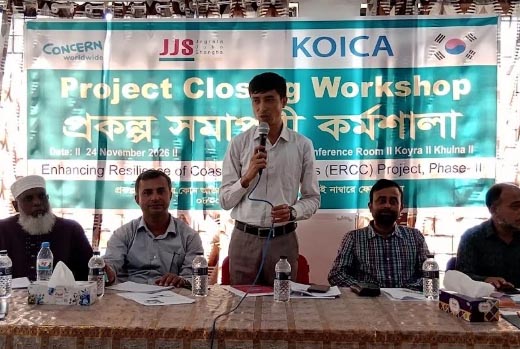
A closing workshop for the ERCC-II project—an initiative aimed at improving the quality of life and enhancing climate resilience for the people of the coastal region of Koyra—was held at the upazila level. The workshop took place on Tuesday (November 24) at 10:00 AM in the conference room of the Koyra Upazila Parishad. Funded by KOICA, with technical support from Concern Worldwide and implemented by Jagrata Yuba Sangha (JJS), the project has directly benefited 2,196 individuals in Koyra Upazila. The Chief Guest at the workshop was Koyra Upazila Executive Officer (UNO) Md. Abdullah Al Baki.

Special guests included Upazila Agriculture Officer Tilok Kumar Ghosh, Senior Upazila Fisheries Officer Samir Kumar Sarkar, Acting Upazila Livestock Officer Dr. Shuvo Biswas, and Sub-Assistant Engineer of the Department of Public Health Engineering, Istiaq Ahmed. The event was also attended by officials from various government departments, representatives of the local administration, members of partner organizations, and project beneficiaries. Md. Nasir Uddin, the Koyra Upazila Coordinator for the ERCC-II project, presented the project’s progress and achievements. He noted that the project, which began in January 2024, facilitated the formation of self-help groups for local female farmers, provided training on climate-resilient “smart” agricultural technologies, offered unconditional cash assistance, and distributed water tanks to ensure access to safe drinking water.

Additionally, the project worked to connect beneficiaries with various government and non-government agencies and strengthened the capacity of local government institutions. According to Md. Nasir Uddin, the Koyra Upazila Coordinator: While the target was to increase the monthly income of beneficiaries from 83 USD to 95 USD, the actual figure reached 105 USD. Under the project, initiatives were taken to ensure that each beneficiary adopted at least three climate-resilient agricultural technologies. It was reported that this has led to improvements in the quality of household diets, increased income, and positive changes in living standards.

During the workshop, women who benefited from the project shared their experiences, noting that the training, technical support, and guidance provided have created opportunities for alternative livelihoods. Despite challenges such as soil salinity, waterlogging, and the risk of natural disasters, they have been able to engage in income-generating activities. Furthermore, the participation of women in household decision-making and social activities has increased. They have also become more aware of the services offered by various government departments.

Speakers emphasized the need for continued, coordinated support from departments—including Agriculture, Fisheries, Livestock, Public Health Engineering, Social Services, Youth Development, Cooperatives, and Women’s Affairs—to sustain the knowledge and skills gained through the project. In his address as the chief guest, Upazila Executive Officer (UNO) Md. Abdullah Al Baki stated that such projects play a vital role in improving the quality of life for residents in coastal, high-risk areas like Koyra. He urged the Upazila administration, Union Parishads, government departments, and local organizations to work together to ensure that the successes achieved are maintained even after the project concludes. Moderated by Md. Mamun-or-Rashid, coordinator of the ERCC-II project, the workshop included discussions on the experiences, challenges, achievements, and future steps related to the project’s implementation. The project is scheduled to officially conclude on December 31, 2026.

Tag :

Please Share This Post in Your Social Media

Write Your Comment

Your email address will not be published. Required fields are marked *

Save Your Email and Others Information

About Author Information
Over 2,000 Women in Koyra See Income Growth Through Climate-Resilient Agricultural Technologies

Update Time : 08:49:42 am, Wednesday, 25 November 2026

A closing workshop for the ERCC-II project—an initiative aimed at improving the quality of life and enhancing climate resilience for the people of the coastal region of Koyra—was held at the upazila level. The workshop took place on Tuesday (November 24) at 10:00 AM in the conference room of the Koyra Upazila Parishad. Funded by KOICA, with technical support from Concern Worldwide and implemented by Jagrata Yuba Sangha (JJS), the project has directly benefited 2,196 individuals in Koyra Upazila. The Chief Guest at the workshop was Koyra Upazila Executive Officer (UNO) Md. Abdullah Al Baki.

Special guests included Upazila Agriculture Officer Tilok Kumar Ghosh, Senior Upazila Fisheries Officer Samir Kumar Sarkar, Acting Upazila Livestock Officer Dr. Shuvo Biswas, and Sub-Assistant Engineer of the Department of Public Health Engineering, Istiaq Ahmed. The event was also attended by officials from various government departments, representatives of the local administration, members of partner organizations, and project beneficiaries. Md. Nasir Uddin, the Koyra Upazila Coordinator for the ERCC-II project, presented the project’s progress and achievements. He noted that the project, which began in January 2024, facilitated the formation of self-help groups for local female farmers, provided training on climate-resilient “smart” agricultural technologies, offered unconditional cash assistance, and distributed water tanks to ensure access to safe drinking water.

Additionally, the project worked to connect beneficiaries with various government and non-government agencies and strengthened the capacity of local government institutions. According to Md. Nasir Uddin, the Koyra Upazila Coordinator: While the target was to increase the monthly income of beneficiaries from 83 USD to 95 USD, the actual figure reached 105 USD. Under the project, initiatives were taken to ensure that each beneficiary adopted at least three climate-resilient agricultural technologies. It was reported that this has led to improvements in the quality of household diets, increased income, and positive changes in living standards.

During the workshop, women who benefited from the project shared their experiences, noting that the training, technical support, and guidance provided have created opportunities for alternative livelihoods. Despite challenges such as soil salinity, waterlogging, and the risk of natural disasters, they have been able to engage in income-generating activities. Furthermore, the participation of women in household decision-making and social activities has increased. They have also become more aware of the services offered by various government departments.

Speakers emphasized the need for continued, coordinated support from departments—including Agriculture, Fisheries, Livestock, Public Health Engineering, Social Services, Youth Development, Cooperatives, and Women’s Affairs—to sustain the knowledge and skills gained through the project. In his address as the chief guest, Upazila Executive Officer (UNO) Md. Abdullah Al Baki stated that such projects play a vital role in improving the quality of life for residents in coastal, high-risk areas like Koyra. He urged the Upazila administration, Union Parishads, government departments, and local organizations to work together to ensure that the successes achieved are maintained even after the project concludes. Moderated by Md. Mamun-or-Rashid, coordinator of the ERCC-II project, the workshop included discussions on the experiences, challenges, achievements, and future steps related to the project’s implementation. The project is scheduled to officially conclude on December 31, 2026.