Silent revolution in mustard cultivation in the potato kingdom of Munshiganj

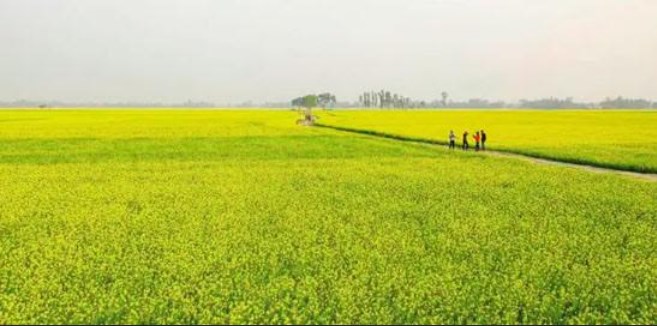
A procession of turmeric is visible in the vast fields of Munshiganj. Field after field is covered with yellow flowers of early variety mustard. The mustard flowers swaying in the cool breeze seem to have added a unique beauty to nature. Such a scene is bringing life to the farmers. Those who extract honey from mustard are also happy.
It is known that due to high profits at low cost and increasing demand for oil, farmers in Munshiganj have leaned towards mustard cultivation this year as well as in the last few years. Mustard oil has become one of the most important ingredients in the edible oil market. At the same time, the demand for mustard oil and seeds in the market has created interest among farmers.
This time, mustard has been cultivated on 4 thousand 793 hectares of land. Currently, mustard can be seen all over the fields in 6 upazilas of the district. It is as if a silent revolution has taken place in the potato kingdom. That is why the colorful dreams of the farmers of the district are blooming with yellow flowers.
On the other hand, in the current season, the government has distributed various improved varieties of mustard seeds and fertilizers free of cost through the Department of Agricultural Extension to increase the interest of the farmers.
According to the District Department of Agricultural Extension, this year, the target of mustard cultivation was set at 4 thousand 377 hectares of land in 6 upazilas of the district. 4 thousand 793 hectares have been cultivated. 400 hectares more than the target have been cultivated. Last year, the target was set at 5 thousand 5 hectares, and 4 thousand 977 hectares were cultivated.
The previous year, mustard was cultivated on 3 thousand 49 hectares of land in the district. As per the target, mustard cultivation has increased this year compared to last year. According to the department, 4,600 farmers in the district have been given 1 kg of mustard seeds, 10 kg of DAP fertilizer and 10 kg of MOP fertilizer as incentives this year.
243 farmers have been given mustard demonstrations and material assistance. A local farmer named Abu Sohan said, ‘We mainly cultivate mustard because the profit is high and the cost is low. Last year, we cultivated mustard at a cost of 5 thousand taka and made a profit of 10 thousand taka. Currently, the price of mustard seeds and oil is good in the market. The government has also distributed mustard seeds and fertilizer.’
Pabna farmers are dreaming of new dreams in mustard. The colorful dreams of farmers are blooming in yellow flowers. Sabuj Molla, a farmer from Panchgariyakandi in the district headquarters, said, ‘Earlier, I used to cultivate potatoes but I suffered losses.
Currently, the price of mustard oil has increased. That is why the price of mustard is high. That is why mustard cultivation is more profitable. It costs 10 thousand taka, and is sold for 20-25 thousand taka.
Cultivation has increased due to government support for farmers with seeds and fertilizers. Nasir Uddin, a farmer from Dhamaran village in Tongibari, said, “This time I have reduced potato cultivation and increased mustard cultivation. I have cultivated mustard on one kani of land. Mustard land does not require much cultivation, and does not require much medicine. The cost is low.”
Farmer Ibrahim Kazi told, “This time, 6 thousand taka was spent on mustard cultivation on 4 ganda of land.
I am hoping that the yield will be good.” Farmer Gafur Chan of Banglabazar Union said, “The yield of improved varieties is higher than that of domestic mustard varieties. Mustard cultivation has been good this year. I hope that the mustard market will also be good this year. This time, we have cultivated mustard on 5 bighas of land.’
Deputy Director of the District Agricultural Extension Department Dr. Md. Habibur Rahman said, ‘This time, a sufficient amount of mustard has been cultivated. Farmers have been encouraged to cultivate mustard as a supplementary rabi crop. The government has provided seeds free of cost. If the weather is favorable, the production target will be exceeded. This time, farmers will get additional profit from mustard cultivation.’