Roundtable discussion titled “The Ebb and Flow of Cox’s Bazar’s Development Journey: Problems, Opportunities and Global Perspective”

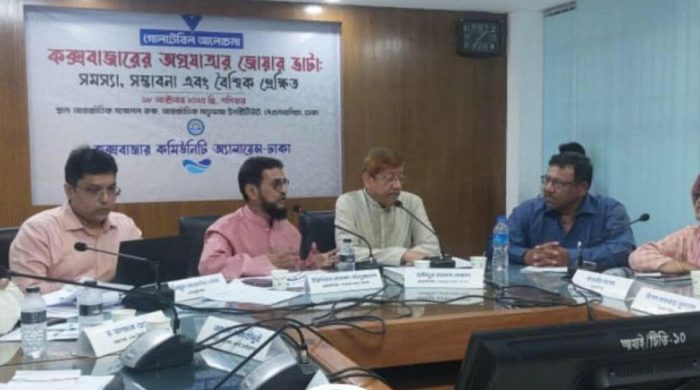
Cox’s Bazar is now not just a tourist city in Bangladesh, it is also emerging as a hub for international business, blue economy and regional connectivity. This idea emerged in the roundtable discussion titled “The Ebb and Flow of Cox’s Bazar’s Development Journey: Problems, Opportunities and Global Perspective” organized at the International Mother Language Institute in the capital on Saturday.
The meeting was organized by the ‘Cox’s Bazar Community Alliance’, an organization of Cox’s Bazar residents living in Dhaka.
The speakers said that the development of Cox’s Bazar has now become part of the global context beyond national borders.
The economy, environment and security—these three trends surrounding the Bay of Bengal—must be taken into consideration together to ensure people-centered and participatory development.
According to them, the future of Cox’s Bazar depends on five pillars: tourism, security, environment, education and infrastructure.
The dialogue reported that in a recent survey by the organizing organization, 86 percent of citizens consider tourism to be the main driving force of Cox’s Bazar’s economy.
84 percent see the Rohingya crisis as the biggest security challenge, and 92 percent want the Chittagong-Cox’s Bazar highway to be upgraded to six lanes as soon as possible.
Hamidur Rahman Azad, former MP from Cox’s Bazar’s Maheshkhali-Kutubdia constituency and assistant secretary general of Jamaat-e-Islami, said, “Cox’s Bazar has a lot to offer the state.
Infinite natural resources, a marine economy and potential people.
This development must be implemented with the participation of the people and local leadership, taking it above politics.”
He emphasized the importance of improving the education and skills of the Rohingya population and researching the mineral resources of Cox’s Bazar.
BNP executive member and former MP from Cox’s Bazar-Ramu constituency, Engineer Sahiduzzaman, said, “Political unity and visionary leadership are essential for the sustainable development of Cox’s Bazar. Tourism security, infrastructure development and proper management of fisheries resources are the need of the hour.”
Coast Foundation Executive Director Rezaul Karim Chowdhury said, “Waste management, clean water and the impact of climate change are now major crises in Cox’s Bazar.
No project will be sustainable without the involvement of locals.”
BUET professor Professor Fakhrul Islam believes, “It is possible to transform Cox’s Bazar into a technology-friendly city on the model of Taiwan through proper planning and application of technology.”
Dhaka University History Department Chairman Dr. Ashfaq Hossain said, “The Rohingya crisis is not just a humanitarian issue, it is a geopolitical issue.
This crisis cannot be addressed without international cooperation and justice-based policies.”
Former Secretary Mafroha Sultana said, “If a corruption-free administrative structure and transparency are ensured, it is possible to establish Cox’s Bazar as an effective development model.”
DUCSU’s Liberation War and Democratic Movement Affairs Secretary Fatima Tasnim Juma said, “It is important for women’s participation and the voices of young leaders to be heard in the development of Cox’s Bazar. Political will and a coordinated strategy must be adopted to curb drugs.”
NCP’s organizational coordinator MM Shuja Uddin said, “Cox’s Bazar’s economy means the economy of South Asia.
The need of the hour is to create the involvement and political trust of the youth for this development.”
AB Party Vice Chairman Jahangir Kasem said, “Cox’s Bazar is now the frontline zone of the national economy.
Without administrative coordination and transparency, the development plan will not be sustainable.”
The participants in the discussion mentioned the establishment of a public university in Cox’s Bazar, government sponsorship for public health protection and development of the salt industry, and beach cleaning and sandbank restoration initiatives as timely and necessary.
In his opening speech, Mohibbul Moktadir Tanim, chief coordinator of the organization organizing the meeting, said, “Cox’s Bazar is not the coast of Bangladesh, it is the strategic horizon of the country’s future development.
We want to establish the concept of responsible development by combining people, nature and potential.”
The speakers’ opinion is that tourism, security, environment, education and infrastructure, these five pillars can develop Cox’s Bazar as a new international economic zone in South Asia.