Farmers in the Sundarbans Coastal Region Anxious Over Aman Paddy Amidst Rains from Cyclone ‘Akvan’

- Update Time : 12:57:16 pm, Saturday, 21 November 2026
- / 4 Time View
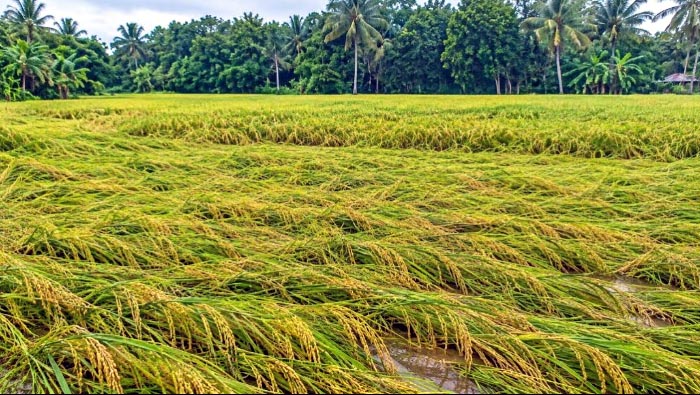
Farmers in the coastal region of Bagerhat—situated near the Sundarbans, a World Heritage site—are facing significant distress due to persistent rainfall triggered by Cyclone ‘Akvan’ during the peak Aman paddy harvesting season. Three days of continuous rain and gusty winds have disrupted the harvesting, threshing, and storage of the ripened paddy. In some areas, the ripened paddy stalks have lodged (fallen over) due to water accumulation in the fields. With the crops in such a precarious state at the final stage, farmers are now deeply concerned about potential yield losses and the recovery of their production costs. Rainfall persisted across the coastal areas from Thursday (November 19) to Saturday (November 21) as a result of the cyclone.
Although the cyclone’s path was directed toward the Indian states of Andhra Pradesh and Odisha, its impact brought rainfall to the coastal districts of Bangladesh as well. Farmers across various parts of Bagerhat reported that as the Aman paddy began to ripen, preparations for a full-scale harvest were underway in many villages. In some places, harvesting had already commenced, but the sudden onset of rain brought all field operations to a halt. Farmers are particularly anxious about fields where the ripened paddy has yet to be harvested. They fear significant crop damage, as the accumulation of water in the fields has caused the paddy stalks to fall over. A farmer from Pagla Shyamnagar village in Fakirhat Union lamented, “I was in the middle of harvesting my ripened Aman paddy.”
“But what a cruel twist of fate—the rain that fell throughout Thursday caused much of the paddy to collapse into the standing water.” “I am suffering a massive loss. I never imagined that after working so hard to grow this crop, I would face such a crisis at the very last moment.” The farmers noted that they had invested substantial capital into Aman cultivation—covering costs for land preparation, seeds, fertilizers, irrigation, and labor. Furthermore, labor costs are currently high during this peak harvest season. Meanwhile, concerns have arisen as to whether farmers will be able to recover their production costs, given that the rain has damaged the ripened paddy. Aman cultivation covers over 25,000 hectares in Morelganj.
According to the Morelganj Upazila Agriculture Office, Aman paddy—comprising both local and high-yielding varieties—has been cultivated across 25,370 hectares in the upazila this season. Of this area, 18,720 hectares are dedicated to local varieties, while 6,650 hectares are used for high-yielding varieties. The total paddy production in the upazila stands at approximately 53,720 metric tons. Last year, 53,929 metric tons of paddy were produced from 26,414 hectares of land. Agricultural officials noted that although the total cultivated area has decreased this year, an increase in yield has compensated for the shortfall in production. They identified the expansion of fisheries (ghers), the conversion of agricultural land for residential construction, and waterlogging caused by excessive rainfall as the primary reasons for the reduction in cultivable land.
Morelganj Upazila Agriculture Officer Md. Saiful Islam stated that farmers in the upazila remain keen on Aman paddy cultivation. This season, local and high-yielding Aman varieties were cultivated on 25,370 hectares. This has resulted in a total production of approximately 53,720 metric tons of paddy. Paddy was harvested from 1,750 hectares in Fakirhat. Fakirhat Upazila Agriculture Officer Sheikh Sakhawat Hossain reported that over 2,000 farmers cultivated Aman paddy on a total of 4,560 hectares in the upazila this year. So far, the ripened paddy has been harvested from 1,750 hectares. He mentioned that there was potential for a strong Aman harvest in Fakirhat this year; however, adverse weather conditions have caused concern among the farmers. According to the forecast from the Bangladesh Meteorological Department, the rain is expected to subside, and weather conditions may improve within a day or two.
Farmers are advised to harvest the ripened paddy from their fields as quickly as possible once the weather returns to normal. Md. Motahar Hossain, Deputy Director of the Department of Agricultural Extension in Bagerhat district, stated that a target has been set to cultivate transplanted Aman paddy on 73,000 hectares of land in the district this year. Of this, 38,000 hectares are dedicated to the cultivation of local, high-yielding (HYV), and hybrid varieties of paddy. Farmers in the coastal region are growing increasingly anxious as continuous rainfall—triggered by a cyclone—disrupts the harvesting of Aman paddy. If the weather does not return to normal soon, the risk of damage to the ripe paddy still in the fields could escalate further.
Please Share This Post in Your Social Media
About Author Information